
When talking about hentai films or women torture films in the golden age of Japanese cinema during the 1970s, the name Tokugawa Onna Keibatsu Emaki: Ushibaki no Kei is often mentioned as a bold and horrifying work. Directed by Yuji Makiguchi, a skilled filmmaker in the pinky violence genre, it presents two stories linked by the cruelty of the feudal system and sexual oppression. Although banned in many countries, it is popular among fans of extreme cinema.
Plot Summary (No Spoilers)
The film is divided into two short episodes set in the Edo period. The first tells of Iori, a young man who falls in love with a Christian woman, but she and her family are arrested during a religious purge. Iori suffers when his sadistic boss takes the woman as a personal slave to take revenge on Iori brutally. The second follows Sutezo, a young man working in a brothel to pay off debts. He befriends a young girl, and together they try to escape to a wandering life by swindling and stealing.
Acting and Characters
Lead actors Yūsuke Kazato and Rena Uchimura convincingly convey the emotions of oppressed characters. Although their roles are limited by the exploitation film framework, they make the audience feel pain and despair, especially in scenes where characters face physical and mental torture. However, supporting actor Akira Shioji as the sadistic boss overacts slightly, but that is the style of this genre that emphasizes excess.
Direction, Cinematography, and Music
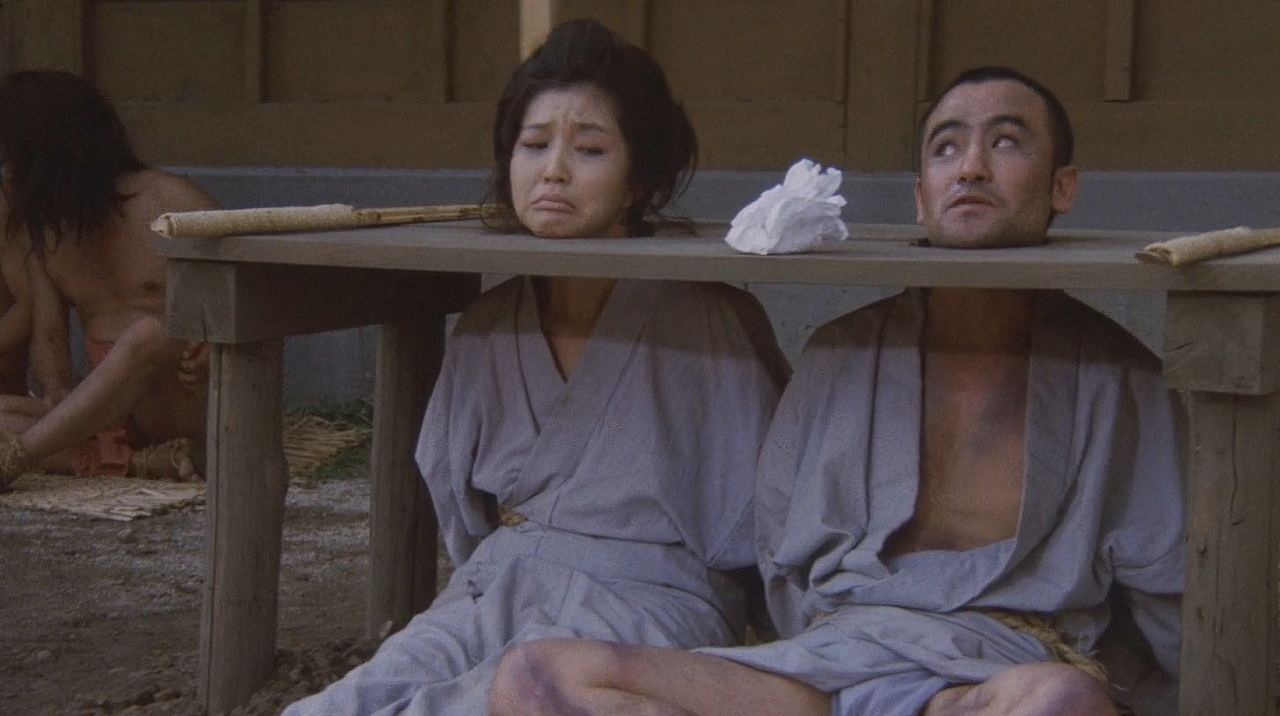
Yuji Makiguchi uses dramatic camera angles and stark lighting contrasts to create an oppressive and horrifying atmosphere. Torture scenes, though censored, retain their brutality. The traditional Japanese-style score enhances the Edo period mood but sometimes overpowers dialogue. Overall, the production is well done within a limited budget.
Editorial Analysis
This film is an example of the 'pinky violence' genre that uses violence and sex to satirize society and power. Although seen as pornographic, it actually reflects class oppression and human rights violations in the feudal era. The parallel stories show cruelty in multiple dimensions. However, the film may not be suitable for those sensitive to violent content or animal torture imagery (the title includes 'cow tearing,' a method of execution). For those interested in this genre, it can be found through various sources, including javsubthai AV with similar content.
Verdict
For fans of extreme cinema wanting to explore the boundaries of violence in film, Tokugawa Onna Keibatsu Emaki: Ushibaki no Kei is a challenging and memorable work. But if you dislike violent content or torture imagery, avoid it at all costs.
Another option worth a look is avsubthai ซีรีส์.
Screenshots


👍 Pros
- +Two interwoven stories with clever structure
- +Good cinematography and atmosphere within a limited budget
- +Reflects social issues of oppression and human rights violations
👎 Cons
- −Violent and brutal content may disturb general audiences
- −Some overacting typical of exploitation films
- −Dialogue occasionally drowned out by music
Top Cast


FAQ
Yes, it includes explicit sexual and torture scenes, though partially censored. It is classified as pinky violence, focusing on violence and sex.
Not directly, but it is inspired by the historical persecution of Christians in the Edo period and various punishments of that time.
It is currently hard to find, as it is a classic banned in many countries. It may be available on DVD or streaming on specialized websites.